
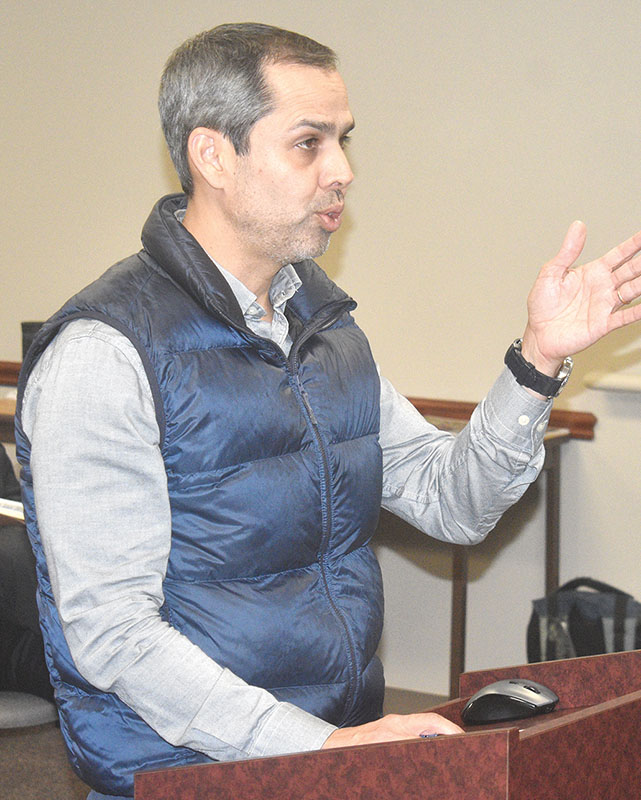
 Bernardo Urdaneta speaks to the Clinton County Zoning Board about a proposed solar facility project between Carlyle and Beckemeyer. The Clinton County Board of Zoning Appeals heard two cases involving proposed solar facility sites in the county on Wednesday, Sept. 23.
The first case was for a site on Highline Road between Carlyle and Beckemeyer. The second site was on the corner of Clinton County Line Road and Highline Road in Trenton.
The zoning Board of Appeals closed the meeting and will issue their decision within 30 days in accordance with state statute.
State legislators have removed zoning citing authority from the county zoning board. What the board had to do was determine if the property meets the state statute that has been passed.
The request for the first case was submitted by Shoal Creek Solar, LLC, and Cultivate Power, LLC, for the operation of a 10 mega watt commercial solar energy facility with an energy storage system on about 46.6 acres. The property is zoned agricultural and is located at 15304 Highline Road in Carlyle. The project is located between Carlyle and Beckemeyer. 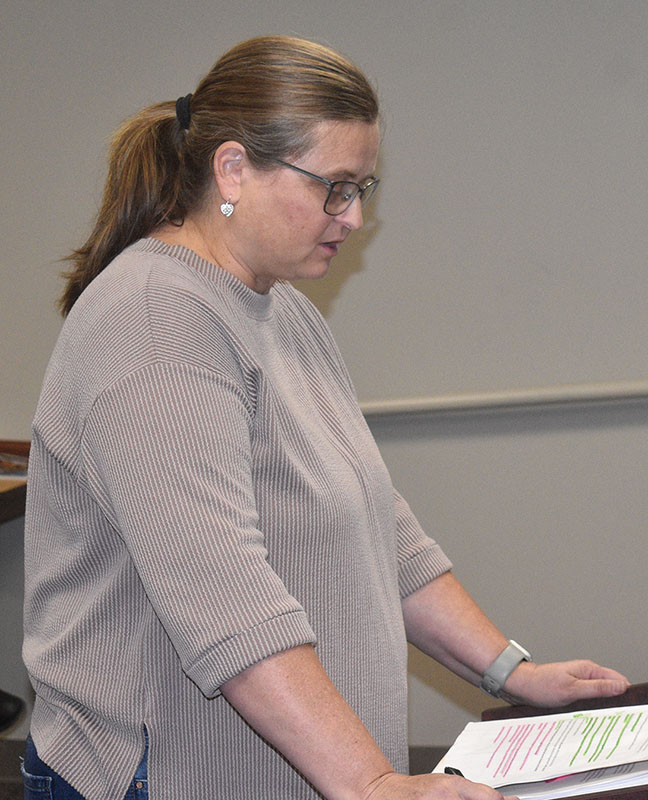 Angie Voss expresses concerns about a solar facility between Beckemeyer and Carlyle. Photos by Matt Wilson Benjamin Jacobi, the attorney for Shoal Creek, LLC, said the project went before the board previously under a prior ordinance and the application was denied. Jacobi said they learned a lot at the prior hearing and since that meeting they have reached out and spoke to every neighbor who would meet with them.
“We are pleased with the progress that we have made,” Jacobi said.
The project is more than 1,000 feet from the closest residence. They took great care to comply with the county’s revised solar ordinance. They provided a checklist to show they would comply with every provision of the ordinance.
“We have complied with your ordinance, including all of the recommendations in your ordinance,” Jacobi said. “The project was very intentional to comply with your local regulations, including the expanded local regulations and recommendations.”
Bernardo Urdaneta, the lead developer for the project, went through slides with the board. The project consists of portable tanks, solar panels, and a battery energy storage system. They estimate the project would generate about 8 million kilowatt hours of electricity annually. The construction period is expected to last four to six months beginning in the spring of 2027. Once construction is complete, the ground beneath, in and around the panels will be planted with pollinator friendly vegetation to stabilize the soil and manage erosion and runoff.
The project will generate additional property tax revenue, create construction jobs, and provide subscription opportunities within Ameren territory. Over 40 years of the project life, they are estimated to generate $1.37 million in property tax payments benefiting the school districts, Clinton County, Kaskaskia College, Wade Township Road District and the Wade-Beckemeyer Fire District.
The Clinton County solar ordinance recommends setbacks of 750 feet from residences, 200 feet from right of ways and 100 feet from property lines. Their design meets or exceeds each of those setbacks. The solar panels are more than 1,000 feet from the nearest residence, more than 800 feet from the right of way, and more than 100 feet from the property line. There will be a 7 foot security fence around the project and access will be through a single entrance.
The equipment will be in the center of the facility.
The battery energy storage system allows electricity produced with the solar panels to be stored then it’s available to deliver back to the grid when demand is higher. The battery units will be located centrally within the project. They will sit on concrete pads surrounded by a gravel buffer.
They have coordinated with the Beckemeyer Fire Department for emergency response and training.
Shoal Creek Solar has entered into an agreement with the Illinois Department of Agriculture covering issues such as drain tiles, top soil management, construction practices and decommissioning.
When the project reaches the end of its useful life, the property will be restored to agricultural use and will be brought back to its original state. The project will provide Clinton County with an updated decommissioning cost estimate every five years. Their current decommissioning cost is about $994,000. The responsibility and financial obligation for removing the project at the end of its useful life rests with the project and not with Clinton County taxpayers.
Urdaneta said they have made a significant effort to listen to the people who live around the project. They hosted a community open house at the Beckemeyer American Legion. They have attended Carlyle City Council and Beckemeyer Village Board meetings to provide project updates and answer questions. They have made community commitments to the Beckemeyer Fire Department, Beckemeyer American Legion and the Beckemeyer Community Development Club to support their needs.
“We appreciate the concerns that have been raised during this process and our approach has been to listen to those concerns, respond where we can, and continue working with our local neighbors,” Urdaneta said.
Thomas Harris from Fire and Risk Alliance said there are different levels of testing and safety protocols that go into battery energy storage systems. The batteries are placed far enough apart that any potential fires would be isolated to a single battery cabinet. They are required to provide an emergency response plan which will be developed in conjunction with the fire department. They also are required to provide training to the fire departments. During the emergency response plan, the developer can identify if the fire department is missing any major equipment that would be required for a response. It is normally standard equipment that would be used in a structure fire response.
When the large batteries run out of life, there are recycling companies throughout the country that will dispose of the batteries.
The solar facility staff was asked what happens if there is an emergency and the Beckemeyer Fire Department is gone responding to another call. Harris said when they do the trainings, they invite mutual aid partners. It is common they would invite five or six departments to the training.
Tracy Becker read a letter that was written by neighbors of the proposed solar facility. They expressed their concerns and objections to the special use permit. Their concerns are not only about solar energy, but they are also about the location of the project and the effect it could have on the properties surrounding it. Many neighboring property owners have invested in property with the expectation they would remain part of a rural community. Homeowners are concerned about future property values.
“A large commercial solar facility and an energy storage system can substantially change the view and character of the area for those living nearby,” Becker said.
There are concerns about agricultural operations including drainage patterns, increased storm water run off, erosion, and the effects the changes could have on their crop ground. They are concerned that runoff could reach water sources used by livestock.
They asked the board to consider how the development could affect the surrounding agriculture ground and livestock operations. They believe the concerns of the property owners who will be most affected directly by the solar project deserve careful consideration.
Angie Voss, who owns a whitetail deer farm near the proposed solar site, asked the board to take a very careful look at the Shoal Creek Solar project not based on emotion or speculation but based on applicant’s documents they supplied to the county.
Voss said the more she reviews the documents, the more unanswered questions she has.
She asked what is being proposed? The zoning information describes a 10 mega watt facility, but the projects’ impact assessment describes a five mega watt project.
“How many megawatts is this, truthfully, because the assessments are saying different than what they are saying,” Voss said.
Jacobi said it’s up to a five-megawatt alternating current and a 10 megawatt direct current solar project. A 10 megawatt direct current project is about equal to a five megawatt alternating current project.
Voss said there is an acreage discrepancy. The project papers say it’s a 46.6 acre project, but the agriculture impact mitigation agreement amendment changes the acreage to 45.5.
Urdaneta said the fenced area is about 45 acres and when you add the access road that is the additional acre.
Voss said the NRCS information included with the project documents identifies soil that can be poorly drained or slow to drain. Voss asked who will establish the baseline condition of the farmland before construction and who will identify afterward that drainage and agriculture activity have been projected?
There also are surface water concerns. Voss said water movement is already an important feature of the property and that needs to be incorporated into the final engineering and drainage plan.
Alli Leach from Westwood said Shoal Creek Solar will be doing a geotechnical report prior to construction so that will give a full soil analysis for the site and that will be a baseline assessment of what the existing soils are.
Leach said whenever the solar farm is built, the grass underneath will be meadow grass which reduces runoff risk.
Voss asked the board to make sure the discrepancies and unanswered questions are resolved before the project moves forward.
“I’m not asking you to decide based on fear, I’m asking you to decide this on complete information which I do not see,” Voss said. “Make sure every significant question has an answer before the ground is broken.”
Voss asked what happens if Shoal Creek Solar, LLC, files for bankruptcy then who would maintain the project and be in charge of decommissioning. Jacobi said that is where the decommissioning bonds come into play. It is state law that solar companies are required to place a bond with the county that the county holds so that they can draw money in the event the company can’t do it itself. The bond is $994,000.
Voss asked in 40 years, what if it takes more than $994,000 to maintain and decommission the project? Jacobi said every five years, the bond is revisited.
“There are lenders in place that would not allow the project to fall into default and be abandoned,” Jacobi said.