
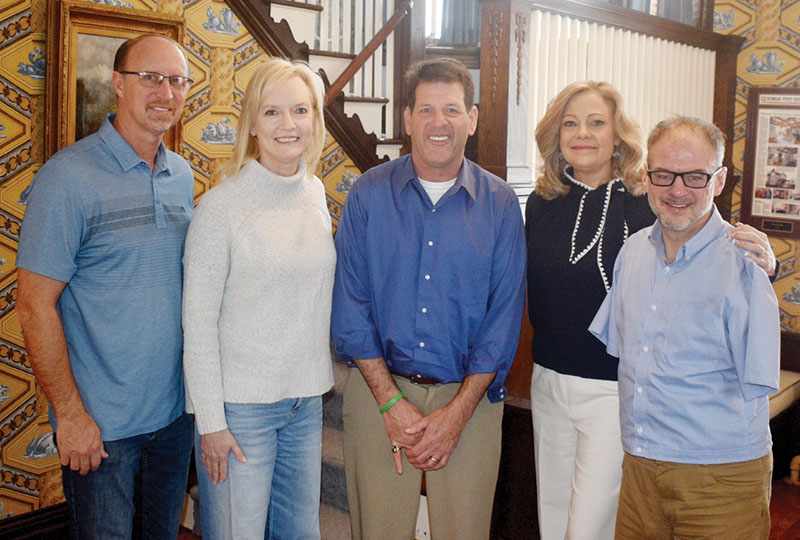
 Members of the Friends of the Forgotten organization are, FROM LEFT, Neil Hustedde, Carol Hustedde, Craig Spihlman, Christine Foppe and John Foppe. Photo by Matt Wilson A group of area residents have been traveling internationally to serve institutionalized children with disabilities and other disadvantages.
Breese native John Foppe founded an international disability nonprofit organization called Friends of the Forgotten. Foppe was born without arms and has spent much of his life speaking and writing about resilience, faith and purpose. Neil Hustedde of Breese is the president of Friends of the Forgotten and Trenton native Craig Spihlman is the director. Also part of the organization are John’s wife Christine and Neil’s wife Carol.
Foppe spent much of his early life trying to feel whole. His first memories are not of home, but of being left at a children’s hospital. At 2 years old, he was admitted to Shriners Hospital in St. Louis for physical and occupational therapy. When his mother and father visited, their presence felt like safety. Each goodbye was terrifying. From his bed by the window, Foppe watched through tears as his family drove away, crying out for them and feeling utterly alone.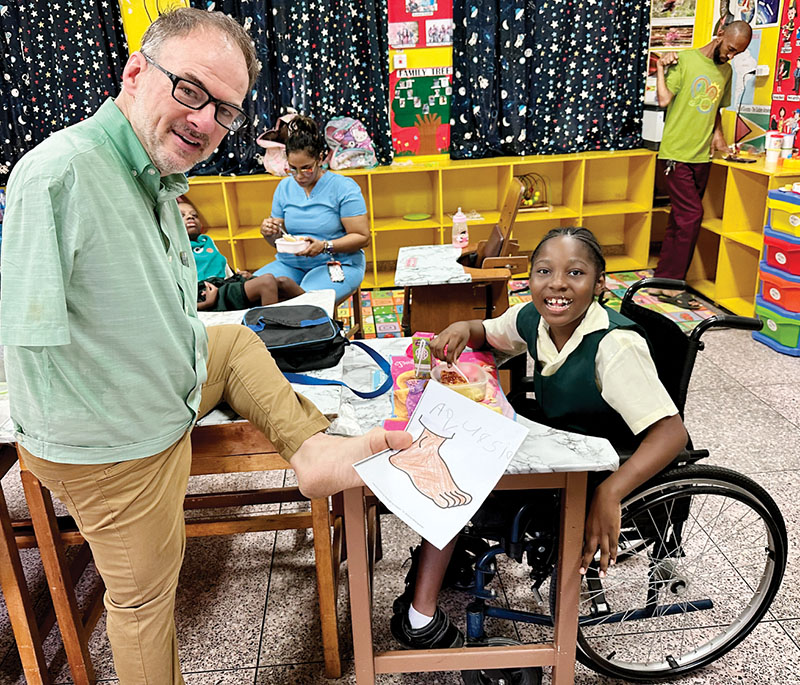 John Foppe shows a picture of a foot a young girl colored and signed for him. Foppe went on a high school mission trip to Haiti. Inside a crowded children’s hospital in Port-au-Prince, a small boy wrapped his arms around Foppe’s waist. He assumed the boy wanted to be picked up, but Foppe knew he couldn’t help him. Fearing he was failing the boy, he cried out to God, asking how he could be called to help others without the physical ability to do so. But in a moment of clarity, Foppe realized the boy never asked to be held, he was hugging him.
“He saw my disability and offered love,” Foppe said. “That hug didn’t just comfort me, it called me.”
Friends of the Forgotten was founded in 2025. It provides free access to speakers, including Foppe, to motivate and empower mission-based organizations and care-giving staff. The seminars renew commitment and morale among mission-based organizations and caregivers, reinforce the dignity of people with disabilities, and equip people with disabilities with courage, motivation, and practical tools to face fears, and recognize that their disability does not define their destiny.
Friends of the Forgotten also prepares disadvantaged children with disabilities for adulthood through one-on-one guidance from mentors informed by lived experience with disability.
Foppe said Friends of the Forgotten is born out of small town values. It is a mission rooted in friendship, not only among the members but also to the folks they go out and see.
The mission of Friends of the Forgotten is to unite adults with disabilities looking for purpose with institutionalized disabled children yearning for love.
“It is a reciprocal mission,” Foppe said. “It’s a mission of disabled people helping disabled people.”
They complete that mission through a couple of different avenues. They go on mission trips where they visit schools, hospitals, orphanages and care facilities. They offer empathy and encouragement and sometimes they lend a hand.
The other core component of the organization is to deliver speeches and workshops. There are a variety of different audiences in the mission field, so the speeches and workshops could be for the children themselves, the staff and volunteers who help run the facilities, and family members and parents.
“It is a variety of audiences,” Foppe said. “And depending on the audience, the message is different.”
Foppe said it is a mission grounded in the theology of presence. That means showing up, being there, spending time, and entering into the moments. He said sometimes children don’t get out of the places they are at, so having a visitor is huge.
The organizations pilot trip was to Tijuana, Mexico. In December, they were in Guyana in South America. They recently came back from Mexico City.
During the trip to Mexico City, they went to three different care facilities for adolescence and adults with disabilities. Those were run by the missionaries of charity.
They visited Chalco Girlstown, which is a huge boarding school for impoverished girls that is run by the Sisters of Mary. There are over 3,000 girls at the school.
“They get taken out of a family environment and there is no phone communication,” Spihlman said. “They go back to their families two weeks out of the year. When they show up at the school, they are put in a group with 17 girls to a room and for the next five years they are a family and a group.”
Spihlman said he has never seen more than 3,000 people smile at the same time, but he did when he was there.
“It was the most joy filled experience I have ever seen at one place at one time,” Spihlman said.
Christine Foppe said the place was incredible and they had a huge classroom to teach the girls how to sew from the design to cutting out the materials and putting it all together.
“Those girls, if they can keep their mental positivity, will have great careers when they grow up,” Christine said. “And it really helps the poverty situation.”
The group also was in Toluca.
When they were in Guyana, John Foppe said he met a girl with no arms. There also was a girl who was in a wheelchair that had a coloring book. One of the pages in the coloring book had a picture of a foot. He asked her to color that page and sign it for him. At the end of the day, she colored the foot and signed it for him.
“It’s just those kind of moments that are profound,” Foppe said. “This mission isn’t about fixing people, it’s about being there.”
The organization partners with mission-based organizations that are operating the facilities. In many situations, those are religious congregations like priests and nuns.
Spihlman and Foppe met in preschool at St. George in New Baden. Spihlman said at that age, they were just curious and fearless. They both attended Mater Dei Catholic High School.
“This is a way for me to create a legacy that you leave behind,” Spihlman said. “This allows us to have an impactful moment where you make yourself vulnerable to let the holy spirit work through you.”
Since they have been friends for so long, Spihlman said himself and Foppe have a unique chemistry that only time can create when they are on mission trips.
“It is a very unique thing that can’t be replicated,” Spihlman said.
Neil Hustedde has more of a background and financial role in the organization. After the Husteddes sold Quad-County Ready Mix in 2023, Foppe asked if Neil would be interested in helping with the organization. He has known John since he was in kindergarten.
“I believe in the mission and it has been a good experience for me so far,” Hustedde said.
John Foppe said they are very encouraged by the positive response and momentum they have. He said the invitation to head overseas is open and the partner organizations are excited to see them come. He said the partner organizations would never dream of bringing professional speakers or trainees because of budgets. He said the generosity of people in the community have allowed Friends of the Forgotten to over themselves for the overseas mission trips.
“People are inspired that this is a different thing and this is not a patronizing charity,” John Foppe said. “This is helping the unfortunate. As this grows and we recruit more disability-informed mentors, it will just increase the reciprocal nature of what we are doing.”
Foppe said they are looking for others with disabilities who are willing to share their experiences. They are also looking for family members of those who have disabilities.
“I call it disability informed,” John Foppe said. “We are open to finding those folks.
He said the more support they get, the more they are able to go. He said there is no shortage of work. There are 5-6 million kids throughout the world who are still institutionalized in about 9,000 different facilities. Many of those facilities are ran by the Catholic church.
“There is always going to be plenty of opportunity,” John Foppe said.
Spihlman said the biggest thing is those moments during the trips that remain in your mind. He said he has received as much as he has given on the trips.
“It has been an incredible experience,” Spihlman said. “When you open yourself up to a unique experience, it really shines through.”
Carol Hustedde said it can be overwhelming to see who they can impact lives. She said on one of the trips there was a child who was unresponsive, but a nun had her belly laughing over something.
“If we make one person’s day a little more joyful, then we have succeeded,” Carol Hustedde said.
John Foppe said the deep wounds aren’t physical, they are relational.
“These are people who are just longing for some attention or some love,” he said. “When you go, a person might be a little startled or curious at first, but then the smiles come. That is just a real moment of joy.”
John Foppe said if someone gives, it helps them stand with someone who has been forgotten. They feel like donors are partners and it only continues because people choose not to look away.
Support includes helping with travel expenses, training materials, and media and communication tools.
Spihlman said they are providing an active legacy that is so real that it’s hard to communicate through a photo or a video.
Foppe said he is in conversations with potential partners in Jamaica, Africa and Romania. He said folks in the mission field are not sitting at computers, so sometimes he can send an e-mail and it might take a week to get a reply.
The future plans for Friends of the Forgotten is to have 10 mission-based organization partnerships formed, 20 disability-informed mentors enrolled, 10 humanitarian trips completed, and 1,000 children impacted.
Friends of the Forgotten works with the Sisters of Mary, Sisters of Mercy, the Missionaries of Charity and the Missionary Oblates of Mary Immaculate.
Friends of the Forgotten can be found on Facebook at friendsforgotten or on the website www.friendsforgotten.org.